


A writer named Stu Woo recently moved from San Francisco to Singapore.1 He got in touch to ask me why I’d also moved from San Francisco to Singapore, and why I’d decided to become a proud Singaporean. We talked about the reasons he and others had moved away from America — the old woman violently shoved out of a Muni bus, the gunshots and molotovs at tech CEO houses, and the simultaneous rise of Hasan Piker’s anti-capitalist far left alongside Nick Fuentes’ anti-immigrant far right. I also mentioned all the positive things that had pulled me towards Singapore, my many posts admiring the country, and my public announcement years ago that I’d moved to Asia.
I am now a citizen of Singapore, a country where my mother tongue of Tamil is an official language, where I can worship at a Hindu temple without insane people denouncing my religion, and where Indian-Singaporeans are full citizens rather than subject to endless racial obloquy. Fundamentally, I voted with my feet for Lee Kuan Yew’s vision of tolerant meritocracy, rather than Kodos or Kang.
As we spoke, Stu Woo volunteered that he personally had no imminent plans to return to America, and indeed might never return. He further acknowledged that millions of centrist Americans had made the same difficult decision to go into diaspora, just like countless liberal Russians, capitalist Chinese, and secular Iranians…because they loved their people, but not their governments.
But — and you might see where this is going — Stu Woo didn’t think it was relevant to include his own decision to go into diaspora, or that of millions of other Americans, in his upcoming Wall Street Journal hit piece on me. The thrust of his questioning, as you’ll see, was to make me look like an odd duck who’d done something weird…as opposed to an early adopter that Stu had literally followed to Singapore. I’ve redacted some of the personal info that Rupert Murdoch’s employees were planning to use in their corporate doxxing attempt, but see the red boxed outline below:
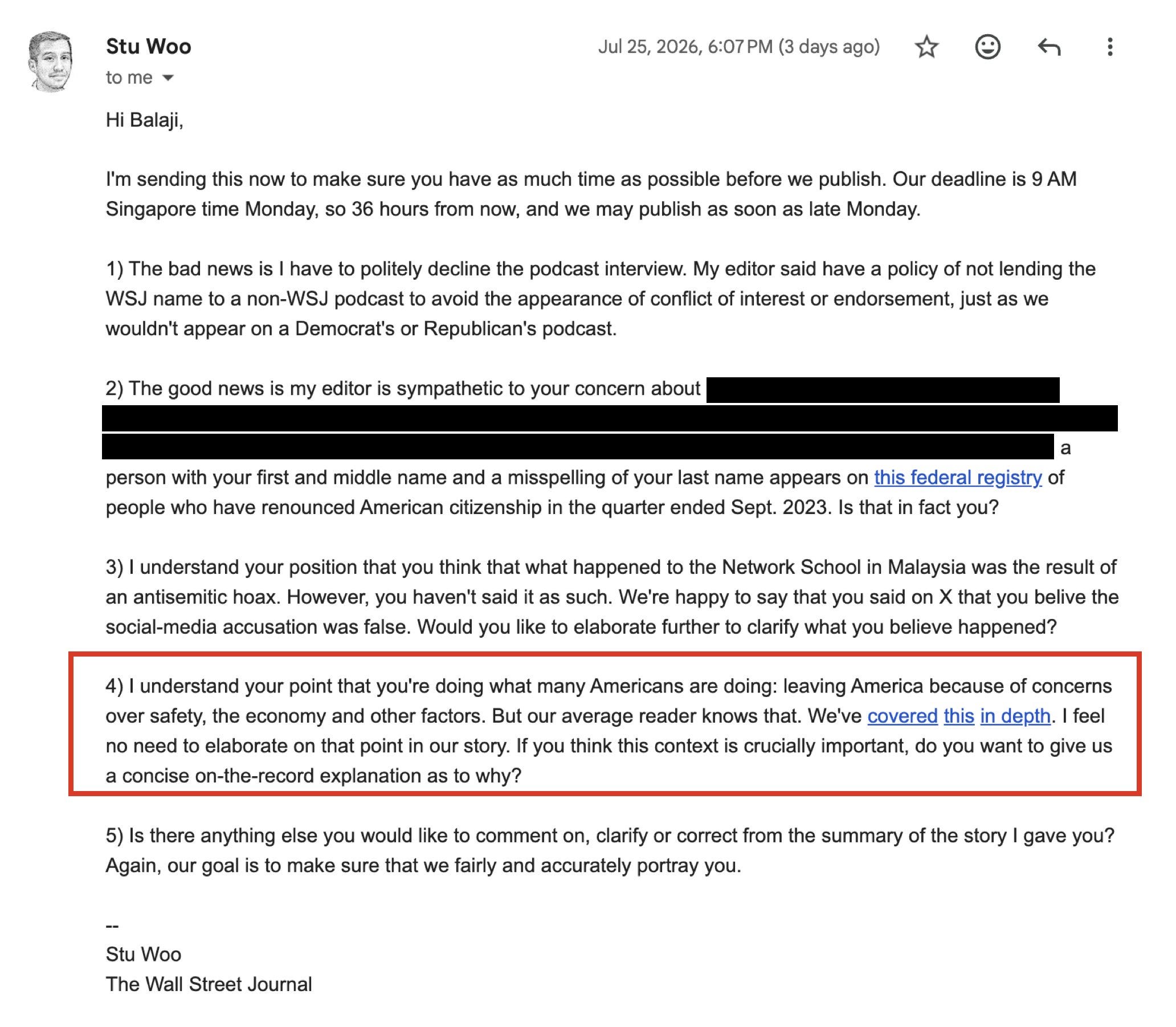
Yes, I actually do think it’s crucially important to elaborate on the fact that the America I loved has declined to the point that millions of Americans are forced to seek new countries, as reported at his own outlet...because it completely defeats their attempt to shame me for moving to another country, as Stu himself did!

So, let’s first go through some lesser-known context on why mass migration and its discontents is the story of our age. We’ll cover (a) the idea of moving faster and escaping things, (b) how the right to exit is the true right to vote, and why (c) every emigrant is seeking a new country. With that context, you’ll understand (d) my response to Stu Woo and the Wall Street Journal.
Move Faster, Escape Things
Millions of Americans have moved from blue states to red. Millions more are moving abroad to places ranging from Canada to El Salvador to Europe to Asia. Millionaires are being forced out of New York, while billionaires are being pushed out of California and Washington. We are talking about situations that have become so intolerable that some of the most capable people in the world — the founders of Google, Facebook, Amazon, Uber, Oracle, Citadel, and SpaceX — had to move from their long-established homes, on short notice, under political pressure. And now that the billionaires have been forced to choose between expropriation and emigration, the “mere” 50-millionaires are being targeted, and soon predictably onward down the income ladder.
The same phenomenon is visible globally, with Russians/Ukrainians/Arabs/Iranians fleeing war, Chinese youth leaving techno-communism, Indians seeking opportunity abroad, and Brits moving to Dubai. The list just goes on and on. Quantitatively, we’ve gone from ~10M migrants per year in 2000 to 35M+ per year by 2025. And due to digital nomadism and internet-accelerated mobility, this figure is only set to rise.
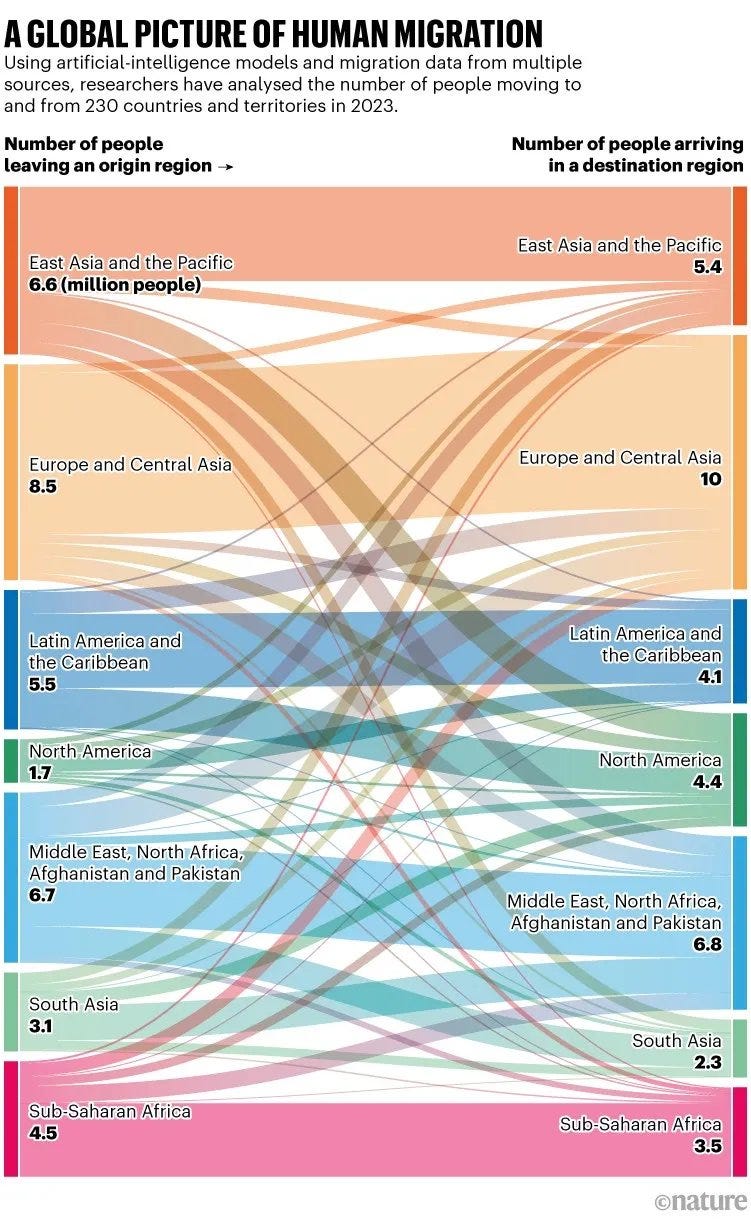
At the same time, a nationalist/socialist backlash against both those coming (the “invaders”) and those leaving (the “traitors”) is rising, both inside the West and abroad. Qualitatively, politicians are exploiting the Curley effect to pass taxes and laws that drive out enemy classes (particularly technologists) and enemy races (particularly immigrants). Within America, this is the common thread between Democrats and MAGA; both are doing their level best via tax policy and visa policy to establish politically homogenous states.
Democrats are de facto pursuing a one-party state (”democracy”, defined as rule by Democrats), while MAGA frames it in terms of a one-ethny state (”Real Americans”, as defined by Republicans). One can make a slightly more sympathetic case for MAGA, because they didn’t really start this, and because if Democrats take power they’ve promised to prosecute them...so perhaps MAGAs see no choice but to build one-party red states in Florida and Texas.

Regardless of the causes, though, both Democrats and Republicans are converging on the same political form as China: namely, a one-party state where elections may be held, but the party always wins. And where the only true vote is the vote with your feet.

The Right To Exit is the True Right to Vote
Just to recap: we’re at the outset of a time where nationalists and socialists will push both (a) forced expulsions and (b) exit bans of enemy classes and races, while internationalists and capitalists will seek both (c) jurisdictions where they’re welcome and (d) the right to exit jurisdictions where they feel unwelcome. The nationalists and socialists will debank, denaturalize, and demonize their perceived enemies; meanwhile, the internationalists and capitalists just need to move faster, to escape things.
Fortunately (and unfortunately), we’ve seen this movie before in the 20th century. And so we have some moral, historical, and economic arguments to bring to bear in favor of the right to exit.
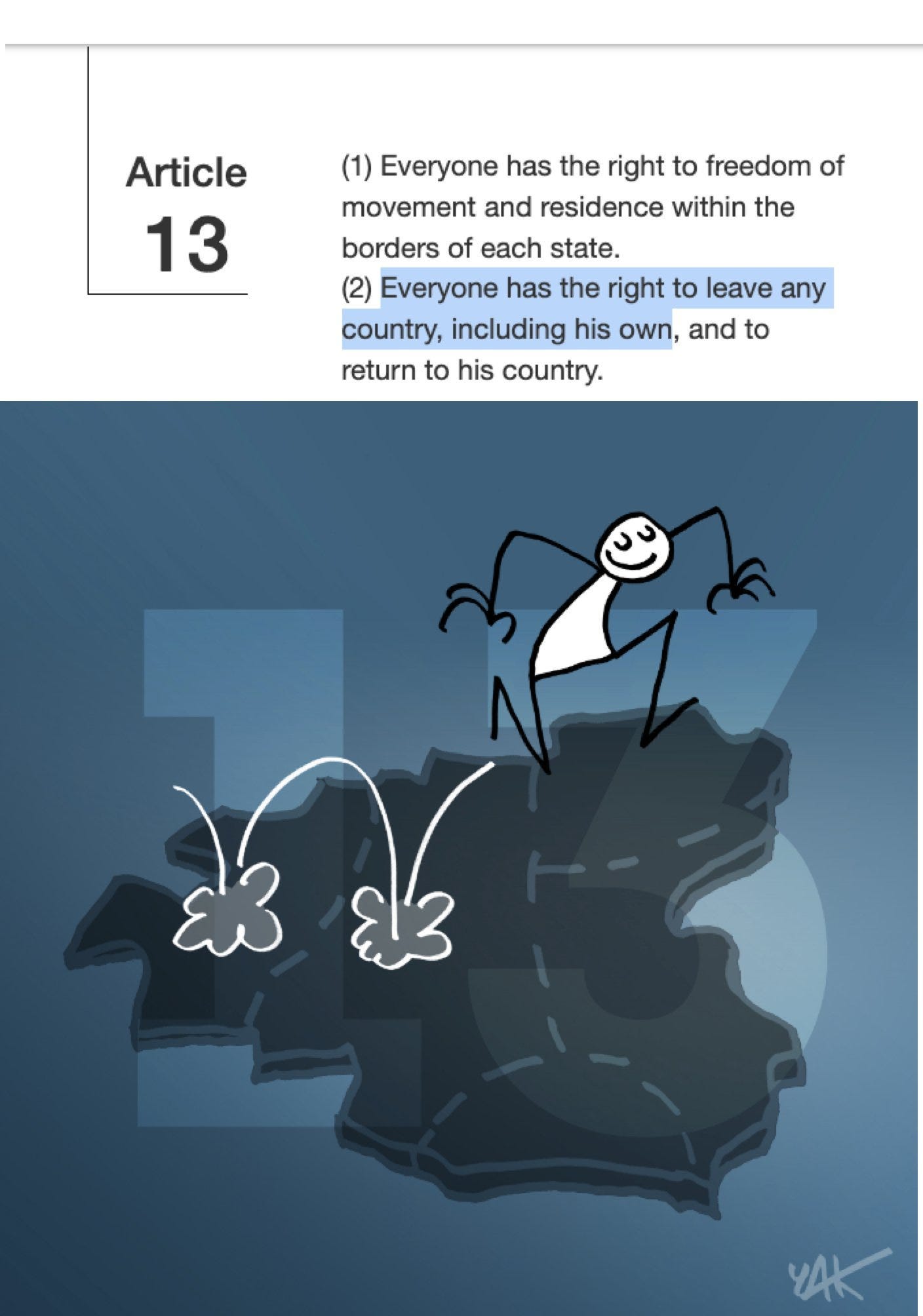
Let’s start with the moral. Article 13 of the Universal Declaration of Human Rights says “Everyone has the right to leave any country, including his own.” This was so important they translated it into 80+ languages. Even made a cartoon. Why?
Because the worst regimes in history impeded the right to exit, including the Nazis, the Soviets, the East Germans, the Cubans, and the North Koreans. When those states weren’t murdering their citizens, they were essentially imprisoning them as slaves. Under Nazism, arbeit did not macht frei. And under Communism, with 100% taxation, you owned not even the teeth in your mouth, and were essentially a slave. So these regimes, the fascists and communists, did not want their slaves to escape:
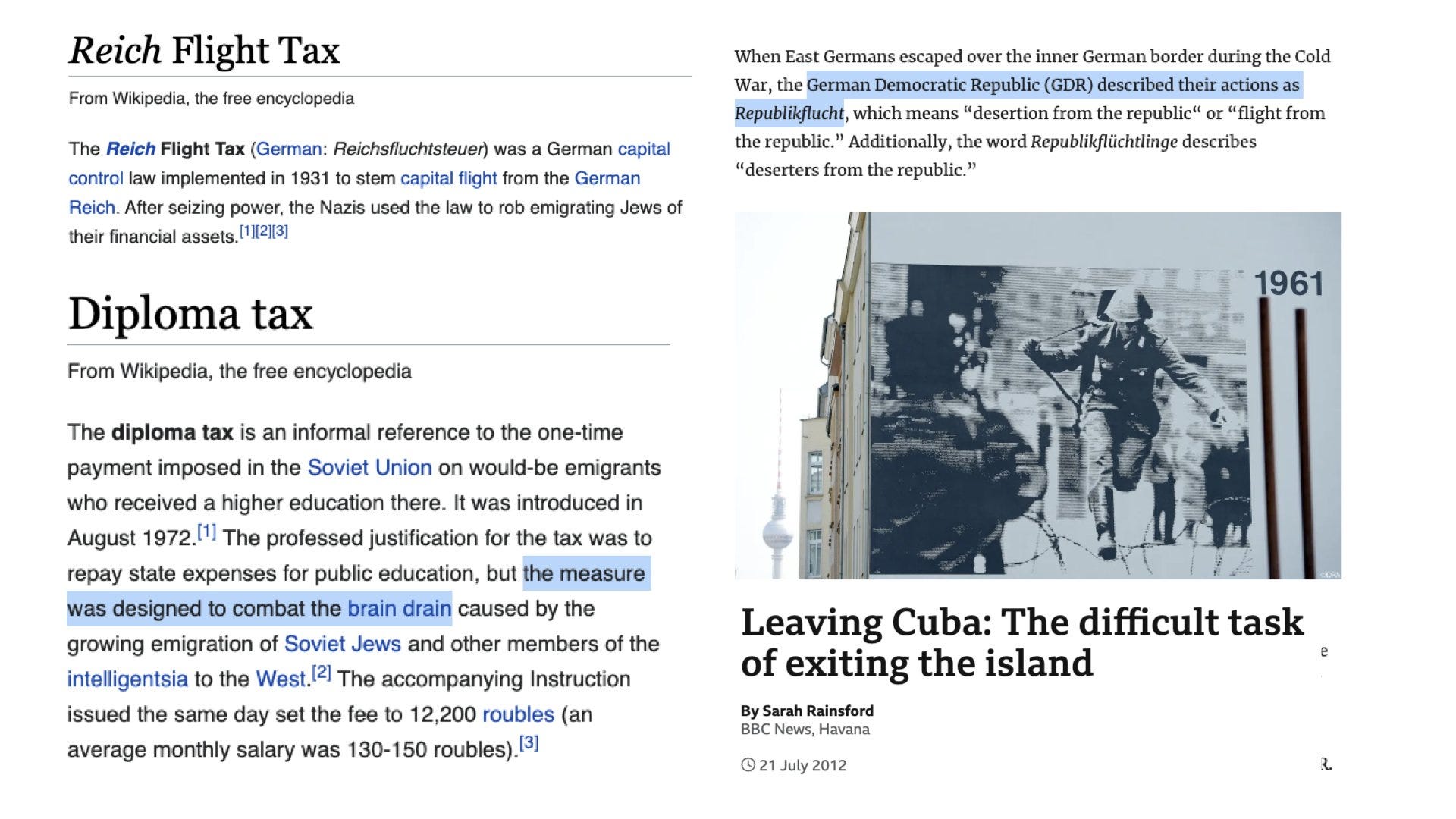
Luckily, there was one country that stood against fascism and communism, for freedom, for the right to exit, for the right for each man and woman to vote with their feet. That country was the United States of America. A specific mechanism was the Jackson-Vanik amendment, which shamed and sanctioned the Soviet Union for impeding exit rights:
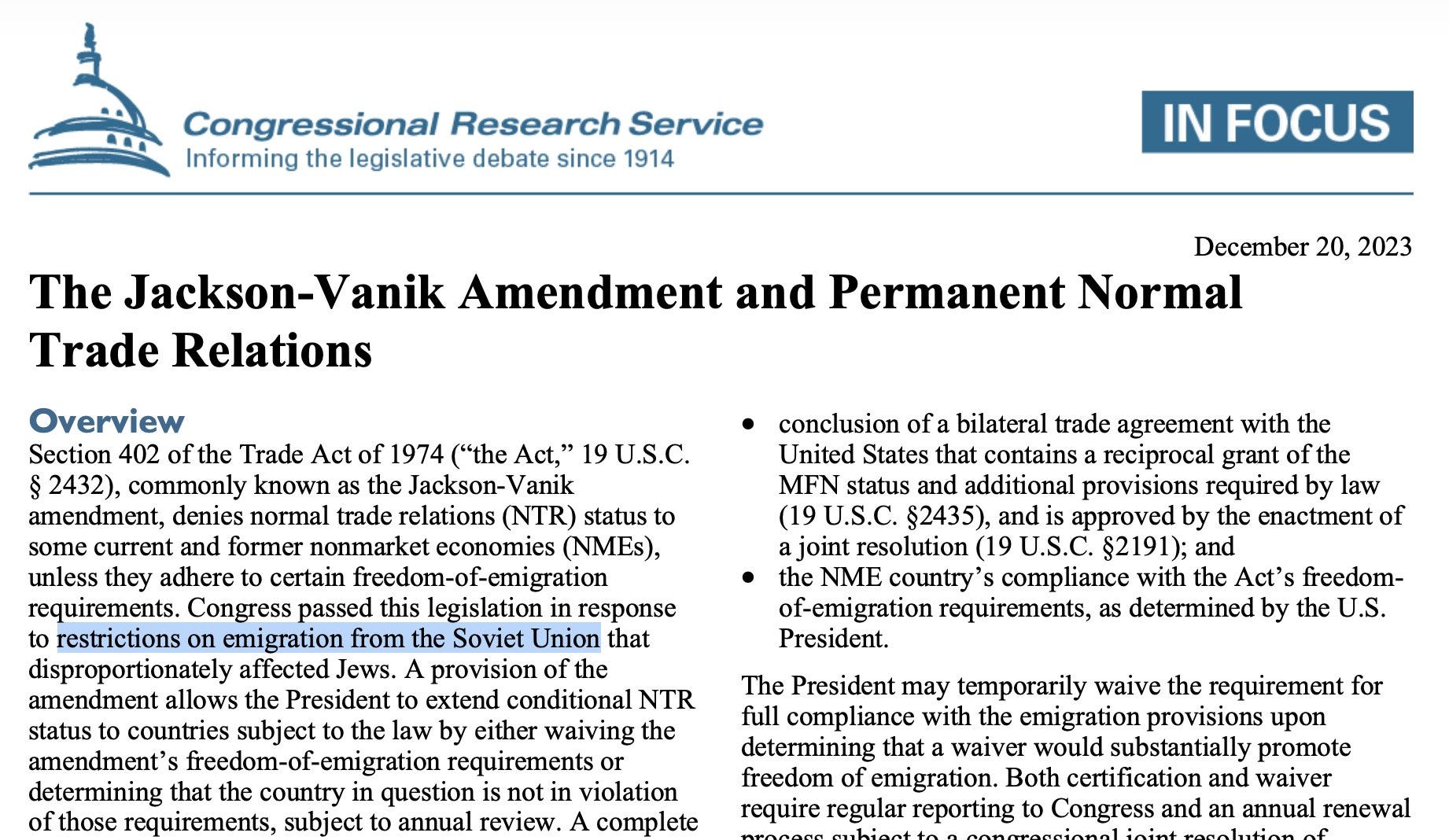
After all, the Soviet Union ostensibly granted everyone the right to “vote” in their faux constitution, but not the right to emigrate. That was the only way to truly vote against the communist regime.
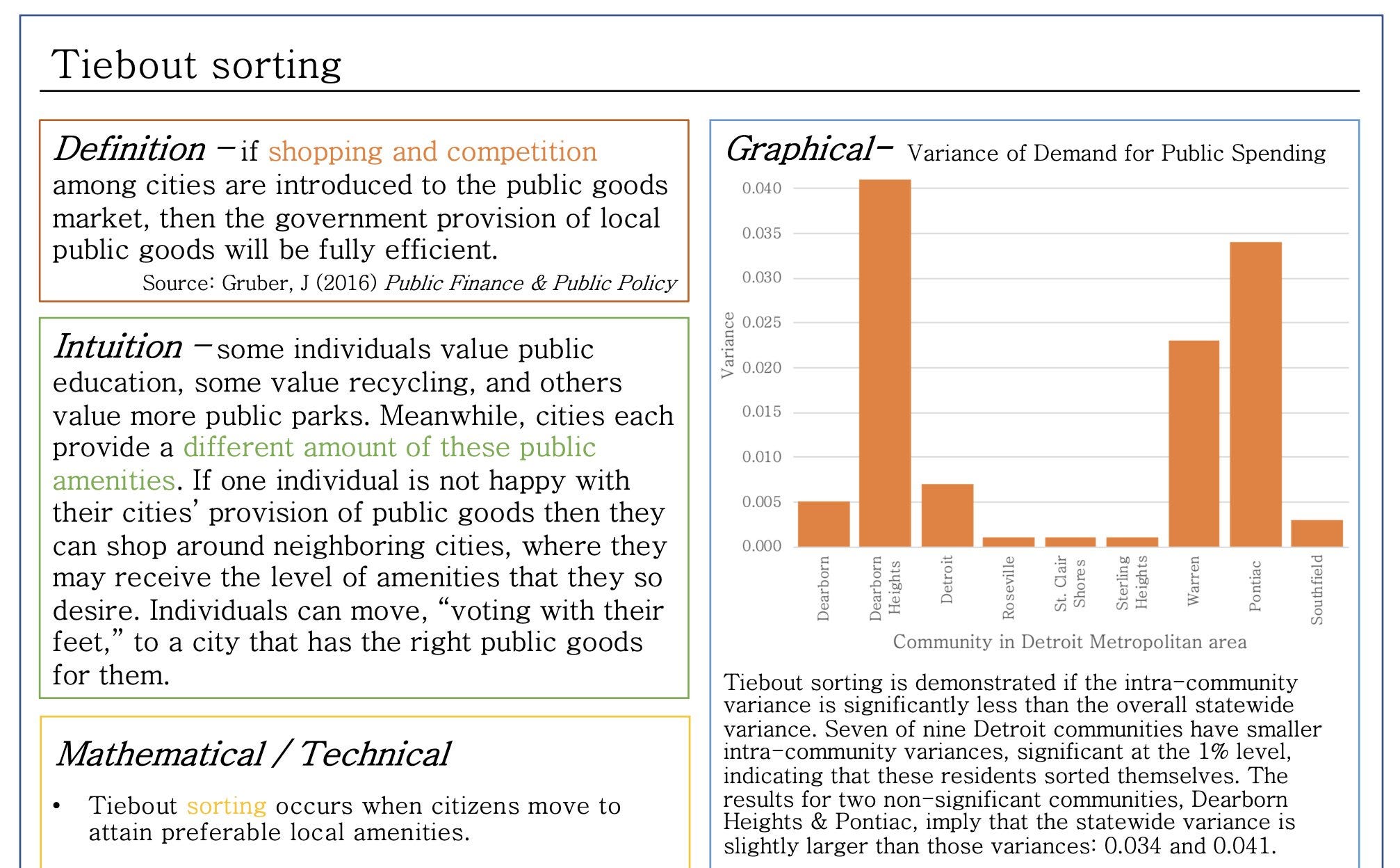
And of course one can also make the economic case via Tiebout sorting that, in the long run, voluntary migration results in better states, because terrible states (like the USSR) lose their talent and capital to the point they eventually go bankrupt, while well-run states attract it.
Every Emigrant is Seeking a New Country
Now you have more context. In brief: 35M people per year now change their countries, including millions of Americans, and including Stu Woo and me. This number is accelerating. The right to do this, to change your citizenship, is a right that America supported with Jackson-Vanik, and that only communist and fascist states historically abrogated. Indeed, the abrogation of exit rights essentially makes you a slave.
That’s why I work on what I work on. I believe deeply in the equality of opportunity that immigration gives, the defense of liberty that emigration protects, and the practical democracy that exit rights represent.
Put another way: every emigrant is seeking a new country. Right now, there are 193 UN sovereign states to choose from, up from ~50 in 1950, an increase of roughly 2 per year:
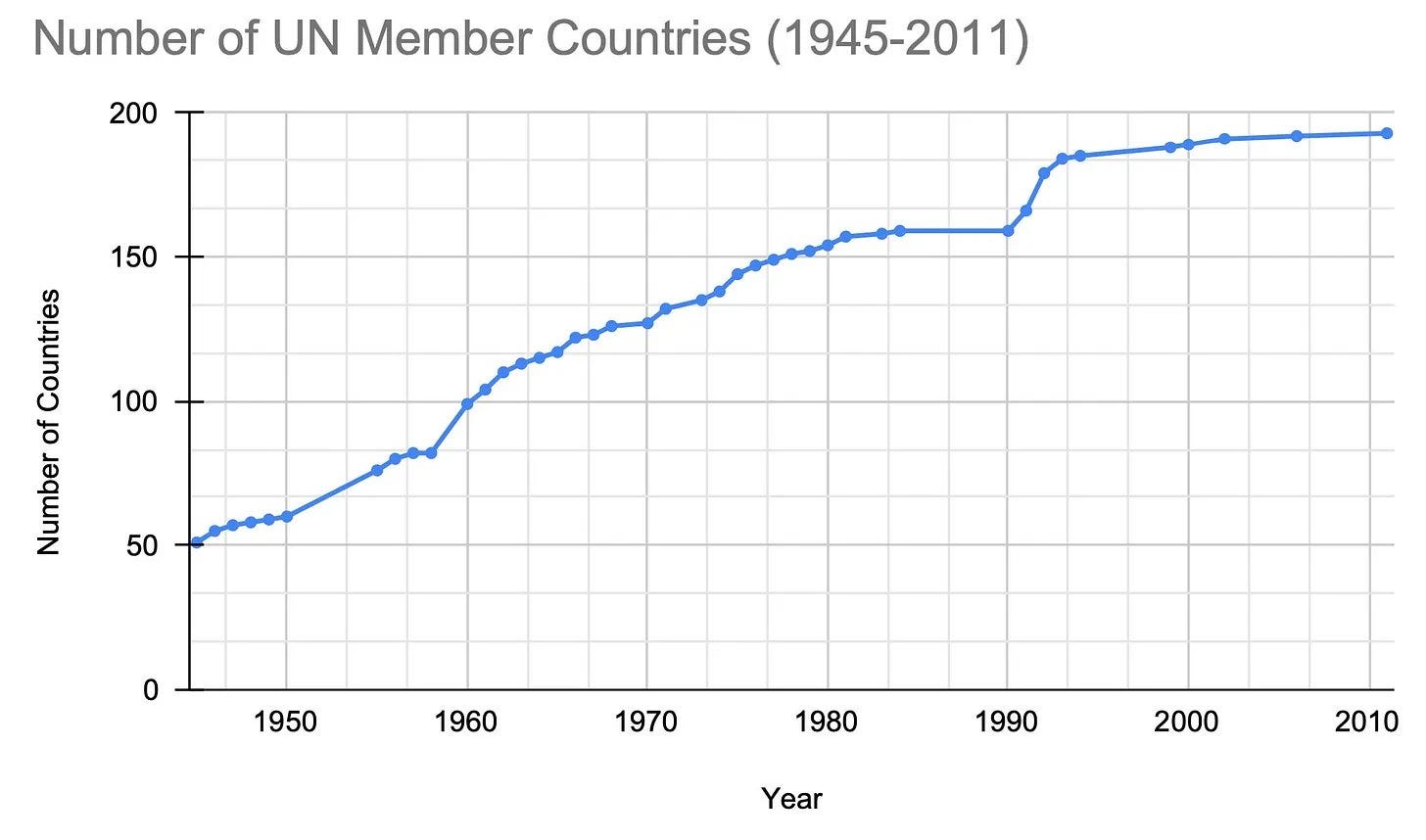
Importantly, there were far more independent jurisdictions before 1950, which was the midpoint of the most centralizing century in history. Thus, I think it’s quite unlikely that this “8-bit world” that we’ve inherited from the 20th century, which still has less than 256 nation states, will continue indefinitely. Because just about everything else humans do has far more than 193 choices. Moreover, if we triple again, from 10M emigrants in 2000 to 35M in 2025 to 100M+ in a few years from now, it will put tremendous strain on the current system.
Among other things, America no longer wants to be the nation of emigrants. So we may need to find new countries that want to be nations of emigrants. This finally brings me to Network School, and Stu Woo.
How the Sausage is Made
Ok. Now you understand the context that Stu Woo didn’t feel relevant to include. In brief: he also moved from San Francisco to Singapore, he also agreed that San Francisco’s governance was in decline, he brought up the old ladies pushed out of Muni buses, he agreed that far left and far right were rising in America, he was also seeking a new country, he agreed that millions of Americans (and non-Americans!) are seeking new countries, and so on.
That’s important because it’s the problem statement. Whether you believe it’s feasible to start new countries or not, whether you think “193 countries ought to be enough for everyone”, step one is to agree on the problem. Without that, you might think what I’m doing is causeless and eccentric, rather than a new proposed solution to the same problem that Stu Woo and I both faced: namely, the political decline of the country we both came up in.
I should also note: Woo has been stalking me for some time, pinging contacts of mine and showing up uninvited at our premises. I only spoke to him because of a particularly egregious doxx he was going to attempt; he did back off from that, which was a little bit like a mugger “agreeing” to only rob rather than shoot someone.
Anyway, without further ado, here are Woo’s emails, with personal information stripped, and my responses inline:
Hi there,We hope you’re doing well! We enjoyed visiting the Network School on Monday – we managed to catch the passport check just before we left – and are close to finishing our story.
Note that Woo says he enjoyed Network School, as our members do! Please keep this in mind for what follows.
We know you haven’t commented to reporters, but we hope you will. This story is likely to be the definitive journalistic account of Balaji in traditional media. It will go through his life, his ambition to build his own country and the plans for the Network School.
The framing is wrong. It’s not “my ambition to build his own country”. My goal to create a process for starting new communities, cities, and countries which I published as The Network State. The book says on page one that it’s a toolbox, not a manifesto. And it’s inspired many other projects from Vitalik Buterin’s Zuzalu to Solana’s Forma to Bryan Johnson’s Don’t Die Network State.
Moreover, the ideas behind startup societies existed before me. You can trace them back to Tiebout sorting, to Friedman’s work on seasteading, to the UN work on special economic zones, and to Romer’s work on charter cities. As Newton put it, we all stand on the shoulders of giants. The network state is essentially an open source project, which is meant to be decentralized and to minimize any dependence on anyone, most of all me. The only reason I did Network School is as a prototype of a startup society, to prove out the concept, and enable hundreds of other startup societies to follow that template.
Nothing is done till it’s done, and nothing is without hardship. But so far, it’s worked well enough that it’s grown to thousands of members, survived a nation state attack, and signed nation state partnerships. If we succeed, the path will be as tough as cryptocurrency was, but I do believe we are on that path.
We’ve heard Balaji repeatedly tout his book as a Wall Street Journal bestseller, and that he has won a Wall Street Journal innovation award, so we’d love to have his participation in this story as well.
I do say that, but that’s from the pre-2013 era when the Wall Street Journal was far more prestigious. It’s like mentioning Yahoo’s IPO, or something. (Which reminds me: we need to fund bestseller lists and awards that aren’t controlled by legacy media. Milner’s Breakthrough Prize is good.)
We may publish as soon as tomorrow. We’re sending you what we call a no-surprise email. It’s a detailed summary of the latest story draft, and it’s intended to give you a chance to correct, clarify, or comment on anything in it. Could you share any feedback by 2 p.m. Singapore time tomorrow? That’s 24 hours from now.
OK. My response below is a no-surprises response :)
Here’s what to expect:The draft is about 1,500 words, making it a longer story for us. It’s > likely to be prominently featured on WSJ.com and the print newspaper.The angle of the story is how Balaji’s vision to eventually start a new country through the Network School is running into the real-world realities of local governments and host nations, specifically Malaysia. The headline and dek will reflect this theme.
This framing is wrong because the entire concept of the network state, like cryptocurrency, was built from the beginning to be robust to the decisions of legacy states, while at the same time working with them pragmatically whenever possible. The fundamental idea is that if cryptocurrencies are decentralized currencies, then startup societies are decentralized communities. We abide by all local laws and then find the locales that want us there.
The story begins in Iskandar Puteri, Malaysia, describing Balaji’s belief that America is descending into anarchy and his ambition to start new countries/societies.
No, the story begins in America, where millions of Americans are now in diaspora and seeking new countries. Some have escaped the far right by going to Canada. Some have escaped the far left by going to El Salvador. Those with European ancestry have gone to Ireland. Others have “gone back where they came from”, and returned to China, Taiwan, India, or South Korea. Still others are digital nomads. And by the way, many people (from the liberals Barbara Walter and Stephen Marche, to the apolitical Dalio and Turchin) believe that America is descending into anarchy.
Point: this story is much bigger than me!

We detail how Balaji launched an entrepreneurial community in Forest City, Malaysia — a largely empty Chinese-built luxury development — setting up a campus with co-working spaces, a gym and a menu with meals designed by Bryan Johnson.
Yes, true.
We plan to quote Balaji from the recent Antler podcast stating: “Bryan Johnson wants to live forever. Sam Altman wants to build a machine of super intelligence. Elon wants to get to Mars… I just want to start a new country.”
This truncated quote removes the humor and context from what I said. Here’s the full quote in italics, which starts at 5:36:
My friend Bryan Johnson wants to live forever. Sam Altman wants to build a machine super intelligence. Elon wants to get to Mars. I just want to start a new country. That’s been done hundreds of times before in history! In many ways I’m like the boring enterprise SaaS of crazy tech things. The reason I say that is in a sense it’s much less radical than the other three. On the other hand, it’s often considered more radical than the other three. Often people are like, “Yeah, you might be able to live forever or get to Mars.” But the thing is those are purely technical things. This is technopolitical. So it actually involves…it’s not just hardware or software, but wetware. It’s the software in our heads, how we think about ourselves.
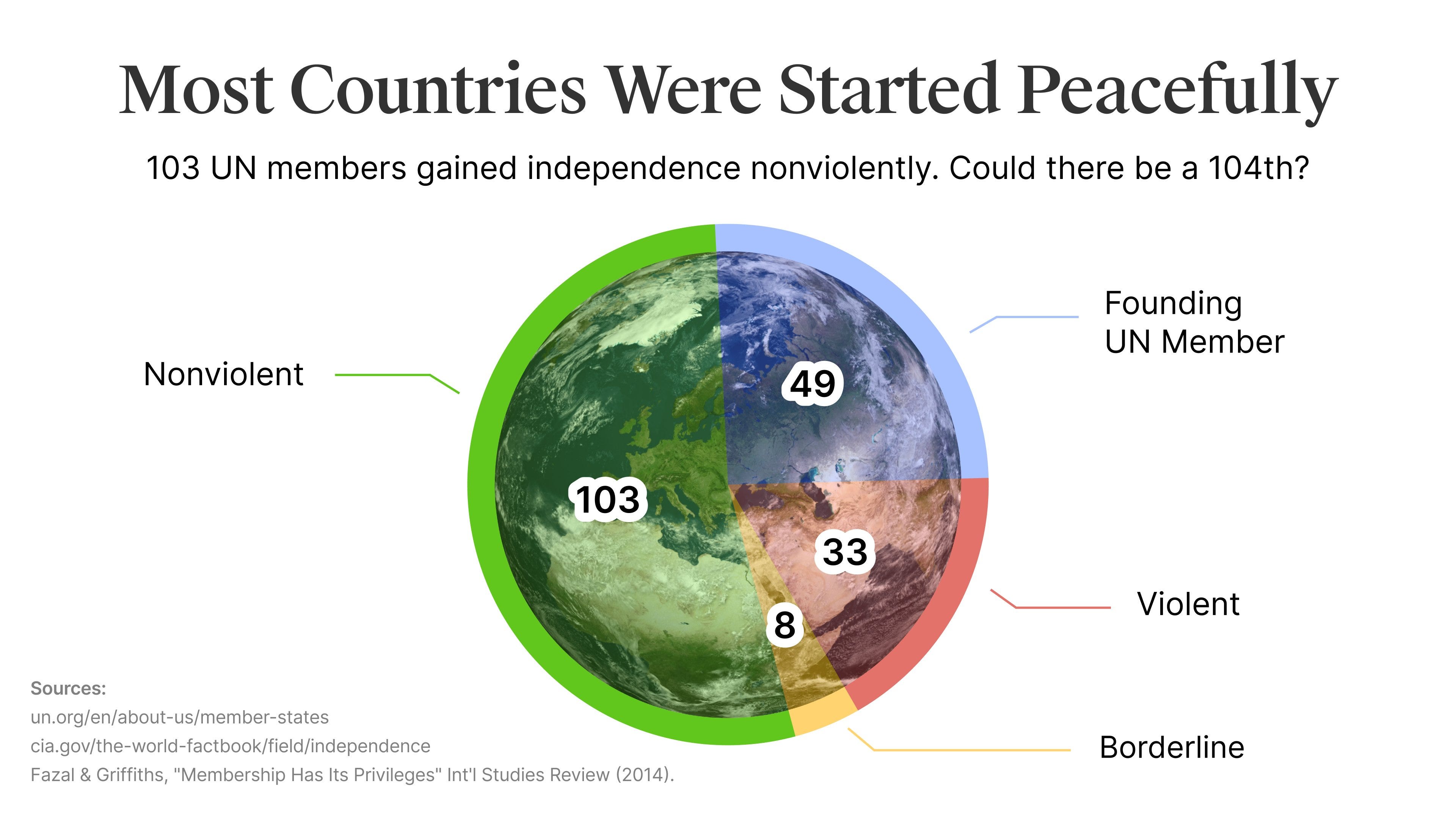
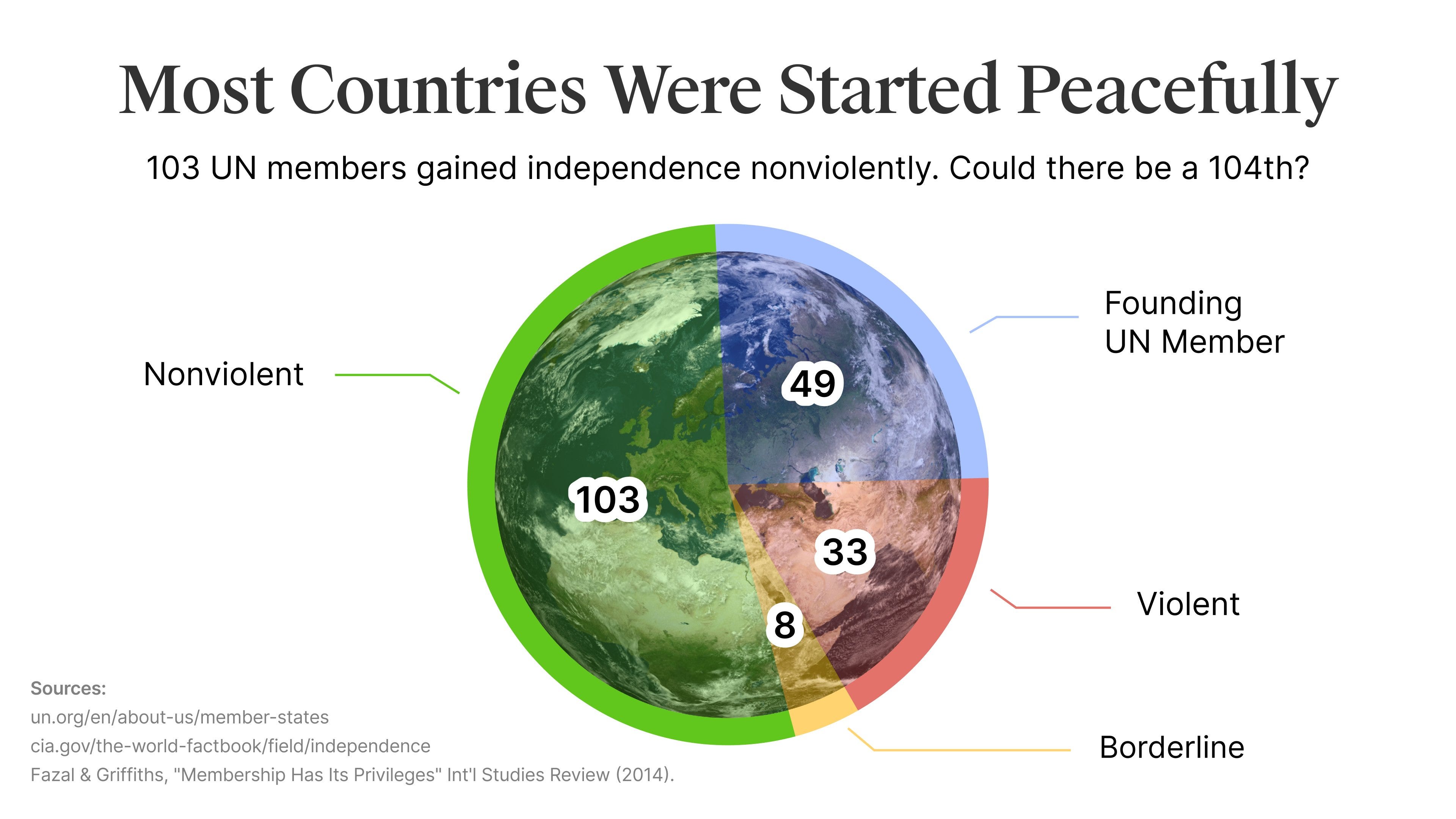
Note that I’m quite aware that it’s considered more radical to start a new country than to get to Mars, and the entire point of what I’m saying is that it should actually be considered less radical because it’s been done many times before. Morever, though it’s a longer discussion, most new countries have actually been started peacefully!
We discuss the Network School experience, noting that participants praised the convenience and camaraderie, but some complained about moldy rooms, quiet nightlife, and a lack of female participants.
This is a false, borderline libelous narrative from anonymous sources. Mildew is common across Southeast Asia, we fix such routine facilities issues as they arise, the explicit point of Network School is self-improvement rather than partying, and we had hundreds of women, families, and children at Network School. Seeing is believing, so here’s a video from a participant:
And here’s our page for families and children:
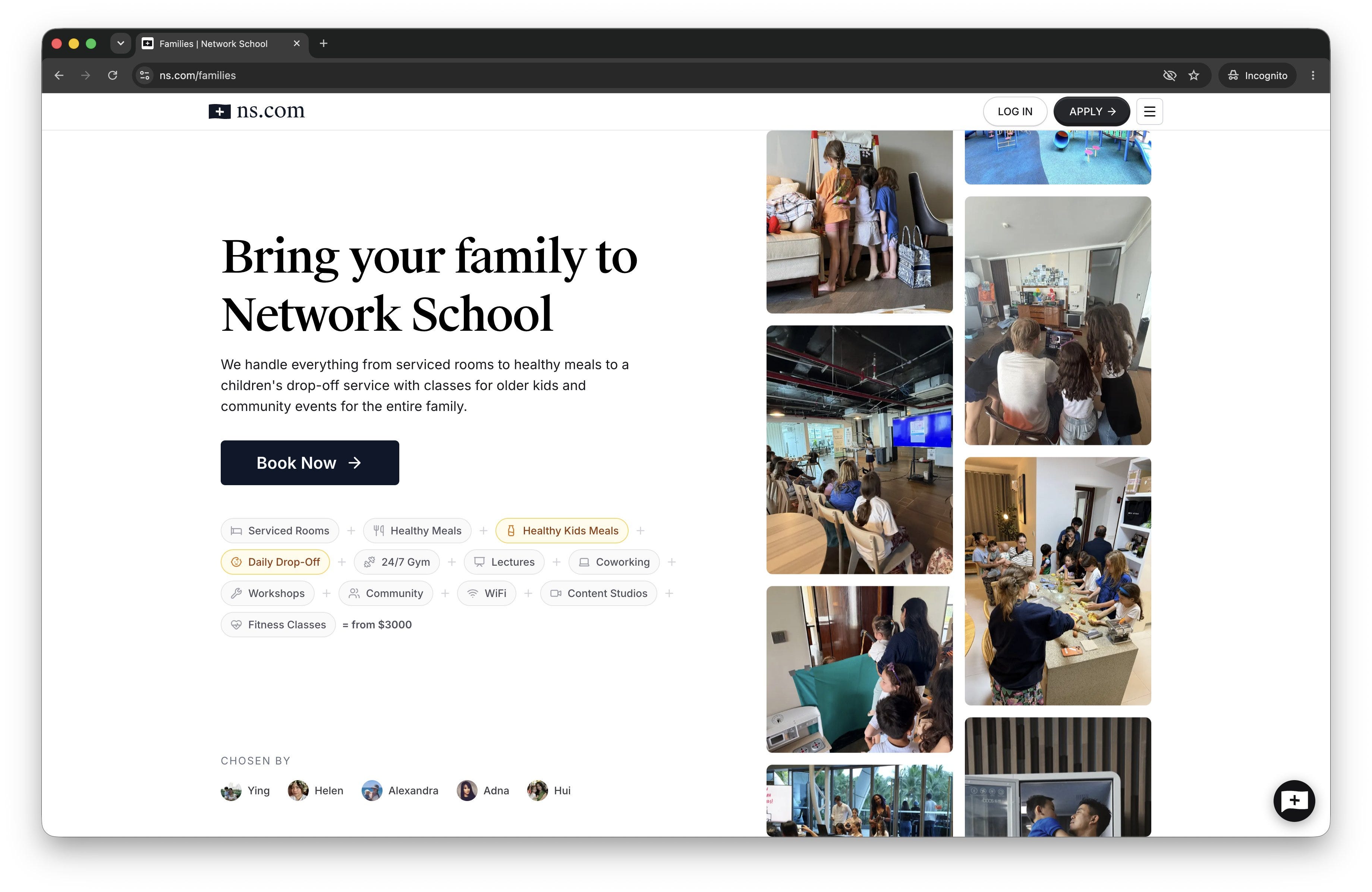
In short, we are absolutely not simply for the “tech bro”, but for the tech dad, tech mom, tech family, and tech children (as well as non-tech people, of course). Recall how Stu said that he enjoyed his trip to Network School? Well, so did literally thousands of others who took an international flight to attend, and thousands more locals.
We include a quote from a former participant comparing Balaji’s shifting vision to Willy Wonka, and a complaint that leadership didn’t actually talk about nation building very much.
Against Stu Woo’s anonymous quotes, in reality, any outside observer would note that my vision isn’t really shifting, given that I’ve been publicly working on the same thing since 2013.
Also, yes, of course, we didn’t talk about nation building very much! I’d already written about that in The Network State. The point of Network School v2 was simply practical community building, while respecting all local laws.
Others said they just enjoyed the convenient gym and food, hated the lack of nightlife, and didn’t think much about the Network State ideology.
Again: no one was coming to Network School for the “nightlife.” The entire thing is about self-improvement: learning technology, burning calories, and earning money with remote work jobs. Members do have fun on their own time, of course, but this is a community for producers rather than consumers. More like Stanford Engineering in the 2000s than Bali.
We detail the recent shutdown by Malaysian authorities following an investigation into whether residents held passports from Israel, a country Malaysia does not officially recognize. We note Balaji’s public response on social media likening the inspection to “swatting” and offering to reallocate capital to other countries. We report that local government authorities ordered the project to cease operations citing licensing irregularities, after which Balaji posted a video with Kazakhstan’s deputy prime minister announcing an > agreement to open a campus there.
This is a grievously incomplete summary of the facts.
First, as preface: I love Kazakhstan and am excited about what we’re doing next. I also still like Malaysia, and I want to be clear that every Malaysian we worked with in real life was great.
In brief, what happened is that an online hoax was posted on July 10 that accused us of harboring illegal aliens, specifically Israelis. But every passport was checked and no Israeli citizens were found. This hoax was indeed “swatting” because it was a provably false report that sent police to our house.
The Instagram hoax kicked off a separate investigation into a different part of the business, which seemed to be resolved when a minister tweeted that our “paperwork was in order”, a post which was then retweeted by the Prime Minister.
Ultimately, however, we were ordered to cease operations within 24 hours by a third investigation by the local government over a signage issue and an MBIP license on one subunit, after being told we had a remedial period. To be clear, we respect Malaysia’s sovereignty and are abiding by all Malaysian law. In the aftermath of this episode, we received offers from several governments to bring Network School to their country, and have signed our first MOU with the Republic of Kazakhstan.
The story contextualizes the Network School within a broader movement of tech leaders attempting to carve out network states and autonomous enclaves, mentioning figures like Patri Friedman, Peter Thiel, and Marc Andreessen, and projects like Prospera in Honduras, East Solano Plan, and Praxis.
Oh, it contextualizes it? Does it mention the fact that CEOs are being shot in the back, having their stores set on fire, and getting their houses attacked with molotov cocktails, to the applause of millions? Does it mention the fact that the founders of Google, Facebook, Uber, Oracle, Amazon, and SpaceX were all forced to leave their home states?
I doubt it. Most likely, it presents what tech is doing as a causeless, idiosyncratic thing. Meanwhile, again, Stu Woo himself left his home for Singapore, for many of the same reasons tech guys left their homes, due to old women getting pushed off Muni buses! The difference is that some tech founders think they can not just move to places like Singapore, but build a startup Singapore. Maybe they’re wrong, but these are founders of fairly impressive things, and it’s worth a shot.
We explore Balaji’s background: growing up on Long Island as the son of Indian immigrant physicians, the bullying he faced in school as the lone brown kid and the unfair punishments for physically defending himself. We quote from the Anthology of Balaji saying that he learned early on that he had to stand up for himself, that the fix was in, and the state is against you. We also write about Balaji’s Stanford engineering degrees, co-founding a genetic screening startup and working at Andreessen Horowitz and Coinbase.
OK.
We quote Brian Armstrong from a podcast describing him as a “contrarian figure” and noting that colleagues previously found you challenging to work with.
Again, that’s not the full context of Brian’s quote. Here is the beginning and end:
“Balaji is a brilliant guy. He’s probably one of the top couple smartest people I’ve ever met in my life…He helped me become a better CEO and have a little more disagreeableness.”
In other words: I do not start conflict for the sake of it. It is true that I had to fire some people at Coinbase, but in general I am mostly good cop and a reluctant bad cop. For example: this journo, Stu Woo, is starting conflict, and I am responding, but that does not mean I am needlessly or typically disagreeable.
We discuss Balaji’s focus on pronatalism and boosting the birthrate, including his quote from a 2023 conference regarding the need for people in space exploration, because many people will die in space exploration and there are a lot of planets out there.
Completely distorted. The question is whether we need more births given that people contend the planet is “full.” The answer is that there’s a whole universe out there and we’ll need people to populate it. But that doesn’t mean you want some kind of human wave to populate space. You want autonomous drones to go first, derisk things, set up basecamps, and the like. Then send humans, but with maximum focus on life preservation. It is true that humans may die in space exploration, but that will happen with everything. No plane crashes, no planes; no train crashes, no trains.
We outline his core philosophy from your 2022 book, “The Network State,” and his blog post explaining the five-stage process from going from an online community to physical footprint and eventual diplomatic recognition.
It’s actually seven steps: https://thenetworkstate.com/the-network-state-in-one-thousand-words
We plan to say that playbook involves people with shared beliefs forming an online community, and then helping each other make money so they can pool funds, buy land and eventually seek recognition as a country
Yes, with the emphasis on community, not company per se. We don’t need to make money, just break even, such that our members have better lives.
We outline the setup of the Network School in Forest City starting in 2024 at $1,500 a month, noting growth in cohort sizes and initially screening applicants on views such as capitalism and pronatalism.
We did initially experiment with an ideological survey in order to cluster people on ideas and recommend friends. I wouldn’t call it “screening” though, because we took in people with many different interesting points of view, so long as they were generally good people.
We include perspectives from attendees, including a digital nomad who enjoys the gym facilities and a program manager from India who attended to jumpstart her career.
Given that (a) thousands of people took international flights to come to Network School, and (b) thousands of locals attended our free events and hackathons, and (c) that membership was steeply ramping up, I think it’s fair to say that most enjoyed it. But see their accounts for yourself.
We will note that before your standoff with Malaysian authorities, you did say that the Network School itself didn’t seek sovereignty and would abide by local laws
We have always abided by local laws, and I’ve said in multiple podcasts beforehand that we weren’t seeking sovereignty in Malaysia. Rough analogy: when Google was in its garage, it didn’t plan to put its future datacenters in its garage, but at some unspecified future location, to be contractually negotiated with the owner of that real estate.
Similarly: we only want to negotiate a special economic zone from a willing counterparty, which need not be the exact country we are in at any given moment. As a concrete example, Egypt leased Ras El-Hikma to the UAE for $35B, less than the $44B that Elon paid for Twitter. So it’s possible.

Finally, we cover your recent agreement with Kazakhstan, noting the country’s efforts to attract tech founders through tax incentives and special economic zones.
Kazakhstan is much more than incentives. It’s a beautiful, amazing country. Here’s a visual:

Fundamentally, Kazakhstan is just wildly underrated. Like Dubai or Singapore, Kazakhstan has competent government officials, talented citizens, diplomatic savvy, clean streets, great aesthetics, multicultural tolerance, capitalism, and techno-optimism. But it also has enormous swaths of low cost land, along with some of the lowest energy and building costs in Asia. This means it is the perfect place to build startup cities, because you can easily get a few hundred acres, along with the talent and capital to build in the physical world. Moreover, because it’s on the Silk Road trade route, it has a culture of positive-sum interactions with foreigners, so it has an enlightened visa policy. And it’s a high-tech country built by traditional nomads, so it culturally understands digital nomads. For all these reasons and more, Kazakhstan may be the perfect location to build digital nomad hubs and diasporic communities.
I should also note that we have committed to fully abiding by all Kazakhstan laws (as we always do) and respecting their territorial integrity (as we always have). We will help the country, build their economy, bring in techno-optimists from around the world, and scale here. At some point in the distant future, with sufficient capital, we may negotiate a 99-year lease with another willing country, just like Egypt’s lease of Ras al Hekmah to the UAE, to get our own special economic zone. Or we may build an artificial island from reclaimed land off the shore of a willing country, or we may even accompany Elon to Mars.
The specifics don’t matter at this point; again, it would be like Google picking out the location of its datacenters when it was still in the garage. A pro-crypto country understands this, because it understands Bitcoin. No one could have predicted in 2009 that El Salvador would be the first country to adopt Bitcoin; Satoshi just started it, the community scaled it, and eventually it achieved diplomatic recognition.
Finally, three questions. We plan to note that you…gave up U.S. citizenship in 2023, based on federal registry records, and that you held a Singaporean visa for tech entrepreneurs.
Note again that Stu Woo himself moved from San Francisco to Singapore! Am I digging through this Murdoch employee’s life for clicks, to make an issue out of a non-issue? Does anyone care what “Singaporean visa” this journo is on?
Note also how Woo frames my relocation to Singapore — which I made no secret of, publicly posting about it years ago — as “giving up US citizenship.” This is like saying that when I moved from New York to attend Stanford it was “giving up New York residency.”
To be clear: I’ve very publicly committed to Singapore. My sons will proudly serve in the Singaporean military, and I organize many free community events for Singaporean families. This is on top of investing millions into Singapore, backing Singaporean startups, bringing global tech figures to Singapore like Naval Ravikant, Bryan Johnson, and Pieter Levels, and hosting huge conferences in Singapore:
In short: I proudly voted for Lee Kuan Yew, rather than voting for Kodos or Kang. I voted with my feet, the only true vote, for the best country in the world. And I should note that many American Democrats share my view (as they’ve come to appreciate Singapore’s HDB flats and bans on racial/religious hatred), just as many Republicans post memes about how based Lee Kuan Yew is.
At the risk of being repetitive: again, as the Wall Street Journal itself has reported, millions of Americans, including Stu Woo, have moved abroad to seek a new life, as is their right as free people, due to the decline of America! Some have moved to Canada to escape the far right, or El Salvador to escape the far left. Some have “gone back where they came from”, by returning to China or India. Some are digital nomads. Some are white Americans who have exercised their right to birthright citizenship in European countries like Ireland, by getting second passports there. Some have moved to Dubai, and some, like me, have moved to Singapore.
To be clear: while I loved the America I grew up in, it just doesn’t exist anymore, due to the rise of the far left and far right. Perhaps we’ll start a new country some day, but right now, Singapore is the country on the planet that currently most reflects my values. Again, to put it plainly: I am a Tamil-speaking Hindu technocapitalist of Indian origin. Singapore honors Tamil as an official language, hosts Hindu temples where we can worship, has many people of Indian origin, and is a global base for technocapitalism. So the far right cannot attack me for my race here, nor can the far left attack me for my class.
Could you clarify the status of current residents in Forest City following the shutdown order, and whether transport or accommodations to Kazakhstan are being offered to existing participants?
We are taking care of everyone individually.
Later, Woo sent another email. I’m omitting the redundant parts, but here’s another question:
3) I understand your position that you think that what happened to the Network School in Malaysia was the result of an antisemitic hoax. However, you haven’t said it as such. We’re happy to say that you said on X that you belive the social-media accusation was false. Would you like to elaborate further to clarify what you believe happened?
OK. I did that above. But yes: an online hoax was posted on July 10 that accused us of harboring illegal aliens, specifically Israelis. But every passport was checked and no Israeli citizens were found. See my notes above for a more detailed response.
4) I understand your point that you’re doing what many Americans are doing: leaving America because of concerns over safety, the economy and other factors. But our average reader knows that. We’ve covered this in depth. I feel no need to elaborate on that point in our story. If you think this context is crucially important, do you want to give us a concise on-the-record explanation as to why?
I did that in this article :)
5) Is there anything else you would like to comment on, clarify or correct from the summary of the story I gave you? Again, our goal is to make sure that we fairly and accurately portray you.
Yes. Stu Woo, you should point out to the reader that you and millions more in the American diaspora like you, as well as millions of emigrants from around the world, are all seeking new countries. All we’re doing is trying to deliver on that demand in a new way.
This is so meta. Taking the Exit from WSJ's legacy walled garden to his own Substack, in response to a story about taking the Exit from USA's legacy walled garden to his own network state.
Well written explanation and expressions. I wish that such rationality and ontological realism were the norm, not the small exception. (Insert Heinlein quote “ … it’s called bad luck.” here.)